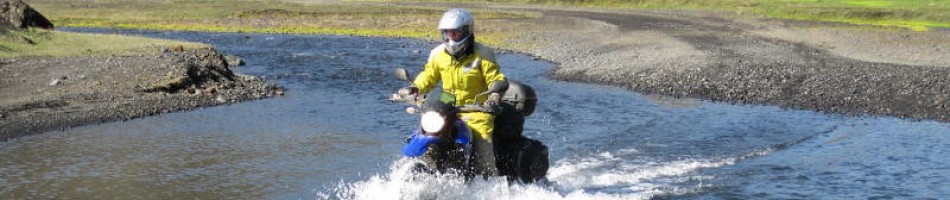
SENA SMH-10 Bluetooth Motorcycle Communicator Eval
Communications are probably one of the single most important topics on trips that are undertaken that are not solo. To ensure that everyone understands what is intended, we must all communicate the plan and we must do it well. Well Kim and I have used a number of the two way motorcycle communicators and we’d like to tell you about our experience with the Sena SMH-10. Overall, we’re pretty pleased.
By way of background, the Sena SMH-10 is the first Bluetooth communicator we have used. Previously, we had used the Collett series of radios the last being the Collett Platinum 900. While we found the communicators to be good performers, we did not find their reliability to be so great. They do have a 3 year 100% warranty and Collett does honor their warranty well, but who wants to have the down time associated with yearly repairs which is what we experienced.

So back to the Sena’s. Overall we’ve found the range performance of the Sena to be pretty good especially considering that it is a bluetooth device. Sena claims a reception range of “up to” 980 yards (900 meters). We’ve found that the distance in unrestricted terrain to be somewhat less, perhaps 500 – 700 yards at best. Frankly, if you are riding with friends, how often are you more than a quarter mile from them? If you are going to be that far away, perhaps you should call them on the phone, eh? For us however, the real world test of performance is in more restricted space such as in the woods or around corners in twisty terrain. Here, the range of the Sena varies significantly.
If you are in the city and are several turns ahead of your riding partner cut off by buildings, range is signifcantly decreased. The same goes for being in the woods. The more dense the terrain, the shorter the range of the communicator. However, we can say with confidence that with all our adventure riding in non-densely wooded terrain, the Sena has given us totally acceptable reception. This is really important to me as I like to know how Kim is doing when we are in the woods and I don’t always have her in sight. I believe the same goes for her wanting to keep tabs on me. As far as range goes, we’ve seen as little as 100 yards in the woods, but frankly we were really buried in there. If you’re looking for a communicator strictly for the woods, you probably do want to look elsewhere though.
As you can tell from R2ADV, we have ridden all over the world and we ride in all sorts of weather and conditions. We are constantly riding in the rain. Pouring rain; as in downpours for hours. We continued to use the Senas in these conditions and we can report that the Sena did not suffer an water related failure in 2 years of use. That’s something that the Collett couldn’t claim. We ended up returning the Colletts 3 times in 3 years for repairs.
We also ride a lot of gravel and in very dusty conditions. Both in South America and during last years Trans American Trail ride, we rode extensively in very dusty conditions where visibility was almost nil due to the bike in front or an ocassional vehicle we caught up to or passed coming from the opposite direction. We literally were covered in thick dust at the end of the day and the Senas still worked flawlessly.
The Sena’s charge fairly rapidly. Ours are the V3.0s and the V4.0s are now widely available. The V3.0s will fully charge in 3 – 4 hours. Sena claims that the V4.0 will charge in 2. We can’t confirm that claim since as we said earlier, our experience is with the V3.0. but it seems a bit strange to this non-engineer that a firmware update would reduce the full charging time. Perhaps an EE can comment in our comment section and voice an opinion.
Ultimately, after two full hard years of use, we have experienced some problems with one of the Senas. One unit must be positioned just right to receive a charge. It seems that there is a poor connection inside the unit. In addition, the audio has become extremely distorted and has almost become unuseable. It transmits well, but the receive audio is so bad it is almost impossible to understand the incoming communication. Since the Sena comes with a 2 year warranty and these units are out of warranty. Unfortuately, we won’t be able to test Sena’s warranty support on the older failing unit. However, we do have a replacement pair that were shipped to us new in non-working condition, so we’ll let you know how Sena handles their warranty service as this plays out.
So when all is said and done, would we recommend the Sena SMH-10. The answer is a fairly enthusiastic yes with a couple of caveats. As long as you are not depending on the Sena SMH-10 for 100% woods riding, or very long distance communications, the Sena is a pretty good tool. Our experience has been with these kind of electronics, a couple of years use is about what you can expect to get for service. Priced at about $300 for a pair, they are not inexpensive, but for the communications, added bit of safety and overall communications, we think they are worth it.
We hope you found this review helpful.
Mike and Kim
Ride2Adventure – Shrink The Planet One Ride At A Time
Transiting The Trans Labrador Highway & Canadian Atlantic Provinces (Part 5)
The ferry Sir Robert Bond effortlessly cruised up the bay so as to deliver us on time and early in the morning in Cartwright. The short overnight cruise had been uneventful and we slept heavily until the morning arrival announcement awakened us. Offloading was a cinch and we found ourselves deposited in Cartwright hungry and in need of fuel. First things first, we immediately made… breakfast the priority.
Not being a very large town, not too far from the ferry dock we found a small diner where the locals were busy getting ready for the day. We joined them, munched down some good local fare and inquired about obtaining fuel. They told us the only gas station in town would open around 8:30 and it was now 7:30. Kim and I looked at each other and decided that with the extra fuel I was carrying we would head on towards Port Hope Simpson where fuel was available and where we planned to stay for the night.
By the way, if you don’t know, click on any one of the pictures in the gallery below and it will open that picture into a full size picture and then you can click your way through the remainder of the pictures in either direction in full size.





-

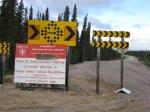
- Somewhere on the TLH.
-
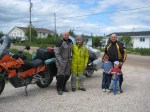
- Dave Noel and his sons.
-

- Just outide Red Bay. If you look closely, you can see the icebergs floating in the harbor.
-
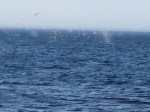
- Look closely and you can see the mist from the whale spouts.
-

- Look closely and you can see the mist from the whale spouts.
-

- Look closely and you can see the mist from the whale spouts.
-
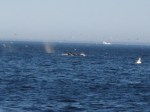
- Look closely and you can see the mist from the whale spouts.
-
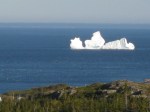
- Icebergs in Red Bay Labrador
-

- Icebergs in Red Bay Labrador
-
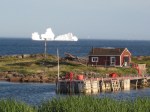
- Icebergs in Red Bay Labrador
-
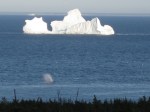
- Icebergs in Red Bay Labrador. Notice the whale spout in the foreground.
-
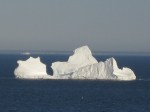
- Icebergs in Red Bay Labrador.
We meandered along the TLH enjoying ourselves and the scenery, just soaking everything in. It was decent weather, we were in no particular rush and in fuel saving mode. We’d been traveling a couple of hours. Cruising along, I looked into my rearview mirror and saw a dust cloud and two headlights coming our way at a high rate of speed. They weren’t spaced evenly so it wasn’t a car or truck. As I stopped to see what was coming, my guess was confirmed. It was our friends Roy and Jeff from the ferry. They had waited for the gas station to open and were high tailing it to try to make the ferry at Blanc Sablon. They had covered in one hour what we had in two. They were moving!
We chatted briefly and they decided to get going so they didn’t miss the ferry at Blanc Sablon. We wished them well and their bikes and their dust cloud soon vanished in the distance. Their bikes having disappeared over the horizon, it was time for us to make our own headway towards Port Hope Simpson to get the fuel we needed and obtain respite from the black flies which had recently made themselves known in full force. In fact, for one photo stop, Kim refused to open her faceshield lest she immediately be swarmed by the nasty little critters. She was right, it was better to keep moving.
After some beautiful riding and some very abbreviated photo stops, we arrived in Port Hope Simpson and found the General Store that also sold fuel. To our surprise, we found some familiar faces. Yes indeed, it was our friends Roy and Jeff from the ferry once again. It seemed that the power was out in town and therefore, the fuel pumps were not working. We chatted and walked into the General Store to find out if they knew when the power might come back on.
The clerk there told us not to worry, that the power should come back on in an hour or so. She told us that this always happened when the guys down at the saw mill turned up the power without calling first and it trips off the breaker. That puts that part of the town out of power until the circuit could be reset. So we waited around for about an hour and sure as the sun rises the power came back on and we were able to fill all our bikes.
Unfortunately for Roy and Jeff, they were now truly under a time deadline and they REALLY had to make a beeline for Blanc Sablon if they wanted to make the ferry before it left the dock. (We found out later that they did make it but only by a matter of minutes.)
Fully fueled, we headed to the only accommodations in town and settled in. We were sitting in our room relaxing when the phone rang. Kim and I simultaneously looked at each other with bewildered looks. Who would be calling us in a little tiny hotel in Port Hope Simpson in northern Labrador? I walked over to the phone and picked it up wondering who might be on the other end.
A unfamilar voice said “Mike”? Yes, I replied warily. The voice on the other end said, “Hi, it’s Dave Noel. We’ve been corresponding on the Ride The Rock forum and I thought I’d come over and say hi.” I was shocked but really pleased. Dave and I had been chatting on the excellent Ride The Rock forum (you can find the link on our links page) when I was planning the TLH ride and Dave had been following my postings on ADVRider.com (you can also find their link on our links page) He took it upon himself to ride over 25 miles on gravel from his home town Mary’s Harbor, just to say hello to someone he had never met. In what other community would that kind of hospitality be shown? I was amazed and pleased to no end. I met Dave in the “lobby” and we went back to our room for a chat and we decided that the three of us would ride together tomorrow for a while. We would meet at Dave’s house and ride from there.
The following morning we easily found Dave’s house and met his family, his wife and two sons. Soon we were on the TLH headed towards Red Bay. The trip had been cool, and along the way we found how cool it had been. It was mid June and we found large patches of… SNOW! More than enough to make snowballs and enough for Dave to try to sneak in a couple of sneaky snowball attacks! However, I am pleased to report that he was unable to connect any either of these New Hampshire natives.
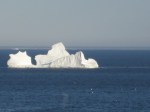
As we approached Red Bay we stopped for a couple of pictures. We were on an elevated portion of the TLH with a partial view of Red Bay. In the distance we could see the bay and I could see white specs in the water. I was somewhat speechless. I told Kim to look closely behind her and look in the bay. Did she see what I saw? Were there really icebergs in the bay? Now we were really excited because neither of us had ever seen icebergs in person. Dave humored us and we descended into Red Bay.
As we approached, it became clear that the specs were indeed icebergs and they were majestic. Sparkling white and huge, they floated silently in the bay. We did not sense any motion, but they floated there like barren white islands of various shapes and sizes, daring you to describe them. Some were gigantic, towering monoliths of ice, jutting out of the water. It amazed us to think that fully two thirds of the berg lay under water. Others were smaller and flatter, still white almost silver in color, again defying description.
We stopped at a small restaurant in town and had lunch with Dave. He needed to get home so we wished him the best and thanked him for taking the time to come and meet us and share this journey with us. We remain friends to this day.
After we said our goodbyes, we rode closer to the bay to gain the best view of the icebergs and yet another magical thing happened. As I was sitting on my KTM staring, I noticed a spray of water in front of the iceberg. Then another, and still another. My mouth dropped agape. I couldn’t believe my eyes. There from the side of the road, right in front of me, were several icebergs and in front and around the icebergs were several pods of Humpback whales feeding! They were breeching and if I listened carefully, I could even hear them blowing. It was a spectacular sight. One that I will probably never experience again. There must have been more than 100 whales feeding.
As I sat beside the road, a local came out of his house and said, “Pretty good show huh?” They were here all day yesterday and today.” I was dumbfounded. All I could mumble was, “Yes, it’s a great show, I am so happy to be here to enjoy it.” So everyone, I was lucky enough to have my little point and shoot camera with me which had a video mode. Because it’s a little point and shoot the video isn’t excellent, but I think it’s worthwhile. Therefore, I am indeed pleased to share with you the best whale watch I’ve ever been on, (including those on boats hehe) that was taken from the side of the road on my KTM motorcycle. You can find it here:
We sat there for an hour watching and listening to the whales. It was an amazing experience. Words just can’t describe it, it’s one of things that you just have to experience for yourself. We could have watched for hours, but we too had an appointment with the ferry at Blanc Sablon and it was time for us to make our way there. So with significant regret, we mounted up again and made our way towards our next stop at Blanc Sablon and the ferry to Newfoundland where we’ll take you in Part 6
Transiting The Trans Labrador Highway & Canadian Atlantic Provinces (Part 4)
We awoke to light drizzle but with an increasing outlook for sun. We were headed for Goose Bay, but we’d have an intermediate stop in Red Bay and it was to be an exciting experience, one that we’d not soon forget. We left our combination hotel, restaurant, supermarket, high school building and packed the bikes. Soon we were off the paved roads of the town of Churchill Falls and back out on the gravel of the Trans Labrador Highway.
As the sun climbed higher in the sky, so did our spirits as the clouds parted and the temperatures rose. Today was going to be a truly nice ride and we were about to reach one of our milestone places, Goose Bay. From Goose Bay, we were going to take the ferry to Cartwright and the final run through Labrador to Blanc Sablon where we’d take another ferry to Newfoundland. Goose Bay was to be , the beginning of another adventure in our adventure. We were psyched!
By the way, if you don’t know, click on any one of the pictures in the gallery below and it will open that picture into a full size picture and then you can click your way through the remainder of the pictures in either direction in full size.


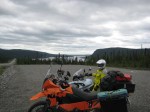


During the day’s trip, the gravel was to transform many times. We were had been impressed with the overall condition of the TLH, the stories we’d heard of how dangerous it was for bikes hadn’t seemed to be true. Caution was indeed necessary as was demonstrated by Kim’s get off outside of Labrador City. But overall, the gravel had been fairly uniform and other than the hazards presented by the road graders, the road condition had been pretty good.
Today however, was a day of road and sky transformations. It seemed that the road condition changed with the sky. The clearer the sky became, the deeper and looser the gravel became. Later in the day as it began to cloud up again, the road firmed up and became almost like pavement. It was truly strange. But enough about the road conditions. We were headed for Goose Bay!
We traveled over and between verdant forests. Many shades of green contrasting on the same hill or mountainside. It was an irregular patchwork of greens, a pattern chosen by nature into a decoration of magical proportions. All the while, we swooped and dived between the mountains on a path of stone and sand. It was a symphony of nature and music for my ears was unnecessary because the music of nature before my eyes played in my head as I rode.
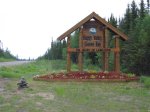
Time passed very quickly even though by this time we were in and out of rain showers. Before we knew it we made it to the greeting sign for Goose Bay and Happy Valley. It had stopped raining for the moment and it gave us the opportunity to take some pictures in front of the sign as evidence that we had made it. Someone had left a marker of their achievement as well and built a rock man figure to the left of the sign letting all others know that people they had been there previously. and now so had we.
Shortly thereafter, it started to rain again and we headed to our hotel for a day and a half layover since the ferry would not be leaving until then. We parked the bikes and unpacked the gear we needed in the rain. Once in our room we dried off and warmed up. It had become quite chilly by this point and the warmth of the hotel was greatly appreciated. Now all we needed was a hot dinner. Luckily for us, there was a small restaurant right next to the hotel and we headed on over.
They were serving a buffet and we passed a gentleman in the line. I guess we look like “bikers” because he asked are you the two on the bikes? We told him that indeed we were. He said that he noticed our New Hampshire license plates and remarked that we had ridden a long way from home. We told him we enjoyed the ride, especially over the TLH and that we were now headed to the end at Blanc Sablon and the ferry to Newfoundland, then on to Nova Scotia. He said he was very interested in our trip and asked if he could join us for dinner to chat about it. Of course we said yes and we had a terrific dinner discussing where we had been and were going on this trip and about adventure riding in general. In return, he told us about himself and his family. He was the local pastor in Goose Bay and had travelled there from Quebec a few years earlier. His flock was growing and he was enjoying being in Labrador where he said could be a part of a community where people were like family. After dinner, we wished him well and we returned to our hotel room feeling like we had become a bit part of the Goose Bay community, we learned about them and they about us. It was a nice feeling.
The following day, I did a little preventative maintenance on the bikes and we did a little looking around Goose Bay. But late in the afternoon, it was time to head to the ferry terminal to pick up the ferry to Cartwright where we continue our journey to the end of the TLH in Blanc Sablon, Quebec. Little did we know that this part of the trip was to become very, very special.
We arrived at the terminal fairly early and found ourselves one of the few vehicles in the lot. Parked at the pier was our ride to Cartwright, the Sir Robert Bond, our ferry. She was a sturdy looking vessel and we were somewhat impatient to get on board, tie down the bikes and get underway for Cartwright. It was to be an overnight trip and we had rented a berth so we could arrive fresh and rested to start the beginning of the end of our TLH ride.
Loading time came and was orchestrated very well. It was an easy process and we were supplied with tie downs for the bikes. Faster than we thought possible, we were on board and ready to depart. We walked around the Bond looking for some dinner and they did have a cafeteria. Well, it was a cafeteria, and the food quality merited the name cafeteria food, but it was food and we were hungry. Fed, we were ready to hit the sack and we adjourned to our berth for a good night’s rest. Along the way, we met a couple of other riders, from all places, Massachusetts, the state right next to New Hampshire. They too had been riding the TLH albeit at a much higher rate of speed. They were really zooming and had covered much more ground in much less time than we had. We had a good time joking around and having fun with them. In fact, so much fun that I guess we drew a complaint from someone and a member of the crew staff asked us to keep the noise down. Ooops!
Our partying done, now it was time to hit the rack. The last of the TLH lay in front of us in the morning and well tell you about this and the very special happenings (the pictures will knock your socks off!) in Part 5.
Alaska – Gravel, Grandeur & Goofy Grins (Part 8)
We hated to admit it, but it was in fact time to leave McCarthy. Time had passed so quickly, I was really somewhat upset to be leaving such a beautiful place. Kim as ever, was taking all in stride and had already packed our gear in plastic bags and was patiently awaiting the van to pick us up and drop us off at the foot bridge so we could walk the last quarter mile or so to our bikes to re-pack our gear. I truly was going to miss the Root glacier and the amazing sights and story of incredible perseverance of all those who had toiled at the Kennicott mine. But I knew there was more to come for us in Valdez and Seward, perhaps even better, and those thoughts buoyed my spirit as we prepared to leave this absolutely amazing place.
Sooner than we knew it, we were back at the foot bridge carrying all our gear back to our bikes to commence our re-packing activities and hit the road for the day and to head for Valdez. After about half an hour, we were ready to move on and we headed back out on the 60 miles of gravel back towards the pavement from whence we had come. It was a faster an easier ride than the previous one since we had already ridden the route but still an enjoyable and exciting jaunt.
By the way, if you don’t know, click on any one of the pictures in the gallery below and it will open that picture into a full size picture and then you can click your way through the remainder of the pictures in either direction in full size.
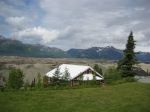
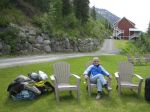
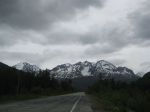


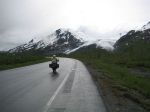




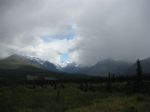






As we approached the pavement, the weather started to deteriorate and we began to experience the first rain of the day. Rain had become one of our friends during this trip and it was no big deal as we motored on happily and the temperature continued to drop. Further into the ride towards Valdez, we started to climb which helped the temperatures to drop even more. The wind began to pick up significantly and the temperature began to plummet. Snowflakes started to fly as they were ripped from the not too distant clouds just above us. They roiled above us and we could see them being swept up the side of the mountains but being halted at the summit by some other competing wind. The sun began to fade and the weather was truly beginning to get nasty.
I radioed to Kim over the communicators to stop so we could add some layers and check our maps for location and distance to Valdez. We stopped to check our map and found that we were almost right in front of the Worthington glacier. It rolled down the side of the mountain in extending two icy fingers in a “V” for victory having made its way across and over the top of the mountain ending right next to the road we were on. It was impressive! It had made it across the mountain where the clouds had been unable to.
After checking our maps, we found that we were not that far away and if the snow didn’t pick up, we could probably make it into Valdez in a couple of hours or less. After taking a few pictures of the Worthington glacier we were off again and headed to Valdez in the snow and rain. As we neared Valdez, the clouds continued to lower and we were concerned that we may hit some really difficult weather and intense snow. But as we entered a canyon, several blue holes opened overhead and the sun burst through in bright flashes. So there was hope to make it to Valdez and there was a sun above! Great!
The road began to twist and turn surrounded with high jagged rock canyon walls covered in greenery. If the weather were better, this road would have been the kind boy racers would enjoy quite a bit. But as nature would have it, there was another show to be viewed that would slow us down. Under a blue hole, in the sunlight, a cascade of white water crashed down from above. Bouncing from prominence to prominence, the water cascaded in a flash of white and a veil of misty fog. We had to stop to take it all in. In fact, while we were there, several folks were similarly effected and chose to stop as well. It was a feast for the eyes; a delicious sight.
After a few photos it was back onto the bikes and only a short jaunt to Valdez. The rain picked up again, but was an on and off affair for the two days while we visited. So in the on and off rain, we decided that it would be a good idea to visit Valdez and meet some of the locals and find out a little about the city.
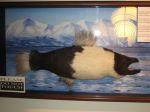
We took the time to visit Valdez’s two museums full of information about the history, establishment and people of Valdez, as well as Good Friday earthquake and tsunami that wiped out most of the city in 1964. We saw a specimen of the extremely rare Alaskan Furry Koho salmon. It was encased in a glass enclosed case so you couldn’t pet it, or eat it. Those Alaskans, they protect their rare species carefully.
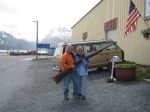
We later met the curator of the museum who gave us the opportunity to have our picture taken with an Authentic Alaskan hunting rifle saying that “everything is bigger in Alaska”. Shortly thereafter he came out with a 7 foot long rifle that you will see in the pictures here. Quite a guy that curator.
Did you know that Valdez claims to be Alaska’s snow capital? We had a chance to check some of their snow removal equipment and if it’s an indicator of the snow they get, we don’t doubt them. Snow machines 15 1/2 foot tall with 5 1/2 tall augers tell of a need to move a lot of snow; and there are several of them. When the auger of the machine is taller than my wife, you know its a big machine.
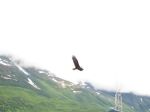
We also saw several examples of the symbol of our country flying around the harbor. Bald eagles are plentiful in the area and they can be seen quite regularly in Valdez. It was great to see them and they are just as majestic as you would think they are.
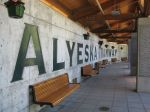
After two days of rain in Valdez, it was time to move on to Seward. By this time, the weather looked to be clearing a bit and we were anxious to be moving in some sun. We planned a full days ride with a couple of stops along the way. The first stop was to be in Girdwood at the Alyeska Tramway, a ski area that has a view of Turnagain Arm. Girdwood is also known for the Girdwood festival which has Alaskan artists, exotic foods and entertainers from all over Alaska. The ride was once again beautiful with curving roads alongside the ocean and mountains. The views were spectacular as the harbor was as placid as a mill pond and it reflected the surrounding mountains. It was a wonderful sight.
We parked at Alyeska and took the tram to the top. It was even more spectacular. From a white snow covered perch, you were witness to an amazing view of Turnagain harbor stretched out in front you. As if by some magical plan, a parasailer floated silently by us and down to the valley floor below. The water of the harbor was blue and sparkled in the sun, reflecting the surrounding mountains. It was perfect.
Again, we could have stayed forever, but we had to make Seward in one day, so we hopped back on the tram and headed down the mountain and got back on the bikes. Not too far from Alyeska, we spied a sign that pointed us to the Wildlife Conservation Center. Kim enjoys seeing “wild” animals so we set our course for the Center. It turned out that it was a drive through center where people drive through with their cars to see the animals. We were on bikes. Hmmm…. do we really want to be in a wild animal center on bikes? Can I really accelerate that hard on a fully loaded adventure bike? Do I really like wild animals that much?
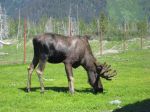
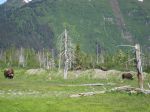
Never fear we were told, all the “dangerous” animals were fenced in. So we paid our fee and visited with bison, elk, moose, musk ox, caribou, and supposedly bears which we never saw (although we saw the pelvis of some poor departed animal in their enclosure). Do you know that a musk ox makes a sound that sounds like a lion’s/tiger’s growl. I’m here to tell you that I heard it up close, and it does and it’s impressive. All in all, it turned out to be a good experience with the opportunity to get pretty close to the animals and see their behaviors. It was money well spent.
Time was indeed fleeting and we needed to get to Seward. So we said our goodbyes to the animals and hightailed it the rest of the way to Seward in clearing and brightening weather. When we got to our hotel, little did we realize that we would once again be surrounded by wild animals. We’ll tell you more in Part 9.
Transiting The Trans Labrador Highway & Canadian Atlantic Provinces (Part 3)
In a misty drizzle just outside of Fermont, we rounded one of the corners beyond a railroad crossing. A road grader had recently passed and left a rather high gravel and dirt berm near the middle of the road. It has also apparently stopped there and made a slight turn because it had left a small pile of gravel and dirt a couple of feet to the right of the high berm. It wasn’t that big but that was part of the problem. It was difficult to see and it was also solid since it was filled with gravel. Soft enough to dig into but not soft enough to plow through.
I was about 100 yards ahead of Kim on my bigger KTM 950 and saw it in time to take evasive action. I don’t know why I didn’t signal her or tell her about the berm on the communicator. I guess I just figured she would see it. Dummy! Well she was on her smaller BMW F650 single and she hit it fairly dead center causing her to fall off and pile drive the big toe of her right foot into the gravel of the roadway. It also knocked off one of her panniers and tweaked the pannier frame and lock.
By the way, if you don’t know, click on any one of the pictures in the gallery below and it will open that picture into a full size picture and then you can click your way through the remainder of the pictures in either direction in full size.






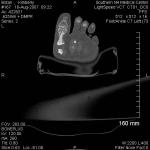
I turned around and Kim was more concerned about the bike than herself. She said her foot was a bit sore but was more concerned about how we would get her pannier closed, locked and back on her bike. (It turns out that Kim had actually broken her toe and rode the remainder of the trip with the second bone in her big toe split in two, almost down the center. I told you she’s pretty intrepid!) I had good tools and with a few tie wraps, a couple of temporary bolts, a bit of bending with pliers and smacking with rocks, we were ready to go again. Of course, the rain had to pick up and we pressed on in the rain and gathering darkness towards Labrador City for a rest and to get some appropriate bolts to fix Kim’s panniers.
When we arrived in Labrador City, it was fairly late; almost 9:00 PM. We hadn’t had any dinner and we were wet, cold, tired and hungry. The restaurant was already closed and we asked about nearby places to eat. It turned out there weren’t any open within walking distance, but the hotel folks graciously opened the bar area to us and got us some hot soup and a sandwich which we gratefully accepted. What nice people!
The following morning, it was still raining and raining with abandon. We went in search of hardware for Kim’s panniers and were given directions to a small store in town. They unfortunately did not have what we were looking for and we were standing in the parking lot trying to figure out our next move when a somewhat familiar voice said, “Hi you two, what are you doing here? We looked over and there was the woman who we had met while we were in a small hotel in Baie Comeau. We had chatted a bit and she had said she and her family lived in Labrador City and they were returning in the process of there when we met them at the hotel. Now here she was at this chance meeting! We told her of our predicament and she said she could help us out and led us to a hardware store that did indeed have the parts we needed to fix Kim’s bike. We thanked her and before we could get her full name and address, she was off. The kindness of people is amazing.
With Kim’s bike repaired, it was only a short ride on pavement until we got back onto the gravel of the TLH. “Civilization” quickly faded as the gravel grew deeper and the trees grew thicker, taller and greener. We were headed to Churchill Falls and we were really into some isolated country. It was gorgeous, but it was indeed immense. Mountains surrounded us in many shades of green. Light green and dark greens literally covering the mountains like a patchwork quilt of trees randomly distributed over and around the mountain sides. Once off the mountains, large plains could often be seen, sometimes populated with thriving green trees or sometimes with the dead trees that had expired in forest fires or been killed by flooding. And as we traveled on, not a glimpse of man made civilization was to be found. Not a sign, telephone pole, street light or manhole cover. It was wilderness and it was amazing.
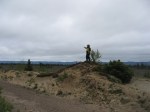
After traveling for a few hours we decided to stop for a snack of a powerbar, some nuts and water. By stopping, the presence of the wide open wilderness became even more omnipresent. It was overcast and no breeze blew. It was very quiet. The road and surrounding terrain was flat and we cold see it disappear around a wooded corner in the distance. Nearby, a large sand berm approximately 10 feet tall offered a better vantage point to view the surroundings so I climbed it to look around. With the view from that berm, I could see even farther into the open and vast space around me, bracketed by verdant mountains. It was beautiful and scary at the same time. I looked down from the berm to see Kim standing 20 yards away and she looked miniscule framed by the surroundings. It was a surreal moment, one where you feel like you are only a very, very small part of the earth.
Wake up! I told myself there’s a lot more of Labrador to travel so I disengaged my mind from the scene and climbed down from the berm. We needed to get to Churchill Falls before dark and we still had plenty of miles to go. After what seemed like many hours in the wilderness, we arrived in Churchill Falls and the beginning of paved road again. Churchill Falls was built exclusively as a town to service the nearby hydroelectric dam. It is a small self sufficient town complete with hotel, high school, supermarket, and restaurant but all are in the same building. When you have to be self sufficient this far out, there’s little credit given to waste. So if you are going to build a large public complex, you may as well build them all together at the same time and that’s exactly what the folks in Churchill Falls did. Bravo.
We did get to experience a bit of what the locals must have to do all the time. When we went looking for food in town, the restaurant was closed because they didn’t have a chef. But we were told that the local bar had food. So we went there but they were a bit low on supplies as well. Kim ended up having fried cod chunks and water, and since I don’t like seafood, I ended up with mozzarella sticks and beer as a 100% nutritionally complete dinner.
The following morning we got up early for our ride to Goose Bay and the first major ferry ride of the trip. We’ll tell you more about that in Part 4.
Signs Of A Great Ride
Sometimes your “adventure travel” can become a bit mundane but if you look around, but even in the mundane there are sights to be seen. I know that as we’ve traveled to many places, we’ve seen signs that have made us say wow! Sometimes humorous and sometimes amazing, not only in print form, you may see signs that make you laugh, think, or take action. Seen any like these…?


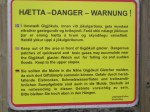

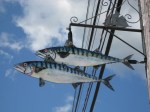


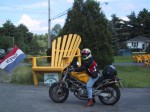
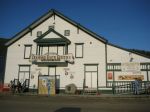

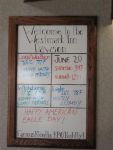


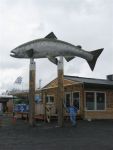


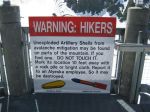


So while you are out on your adventure, make sure you always stay alert for signs of adventure.
Ride2Adventure – Shrinking The Planet One Ride At A Time
Alaska – Gravel, Grandeur & Goofy Grins (Part 7)
As we had seemingly been waiting for all day, we finally came to the fork in the road where we left the pavement and hit the gravel for the sixty mile jaunt to McCarthy. Almost immediately we began a fairly significant climb on a loose gravel surface road with no guard rail. It was quite a way down to the water below, but we were by this time quite use to the feeling of riding mountainous gravel roads with no guard rails. We continued further into the road and civilization quickly started to vanish. The road became a single two track that had us wondering for a while whether we had actually made the correct turn to McCarthy. Grass grew three inches high from between the two well defined wheel tracks and the trees closed in to only a few feet from the sides of the tracks. The road was beginning to look more like a trail than a road.
Hmmm… After about 20 minutes of this type of riding I began to wonder whether we were indeed on the correct road. But shortly thereafter, the road began to widen and some beautiful vistas became evident. Below us glowing a bright silver in the late day sun was what/who we would find out was the Copper River. She was wide and wonderful, carving large sweeping swaths between the mountains, sometimes running fast with white water, and other times merely dawdling along. She was full of life and effortlessly showed her power while letting her magnificence be known. She was breathtaking and she knew it.
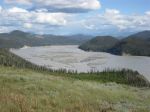
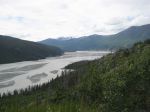
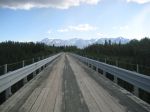
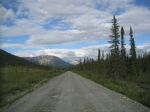


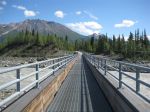
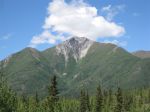
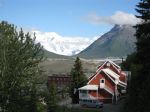
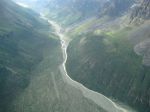




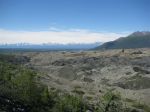
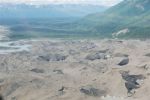



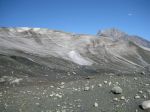









Onward we rode and signs of civilization made themselves known in short spurts along the way. A few houses huddled here and there, out in this wilderness among the towering trees, mountains and bright blue sky. However as we continued deeper into the forest, we came to recognize that to live here you must be sturdy and self sufficient. Here, the laws of nature come first and are in control, not the laws promulgated by man. Winters with double digit sub-zero temperatures and snow measured in feet not inches are not for the weak of body or mind.
Nearly two hours after leaving the pavement, we came to the parking lot (yes, parking lot!) for the place we would be staying for the next few days; the Kennicott Glacier Lodge. We had found this place nearly by accident on the web and when we found what it was near, we decided we had to visit. But here’s the deal, you can’t ride or drive there yourself (without permission from them which is almost never granted). You must take a foot bridge across a section of the Copper River to a waiting van that will drive you the last couple of miles to the lodge. In all honesty, there are other means to get there, but the natives keep that to themselves and it’s only fair to leave it that way for them.
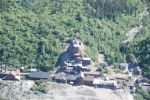
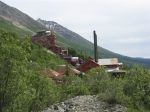
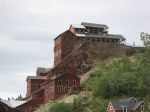
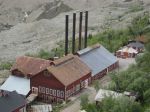
So what’s so good about the Kennicott Glacier Lodge you ask? Well despite great accommodations in the middle of the Wrangell-Elias mountain range, it’s located directly beside the Root Glacier and a short walk from the Kennicott Mine which is now a National Park maintained in a state of arrested decay by the National Park Service. As such, it looks like an abandoned mine that it is, but it is not being permitted to decay any more than it has to date. Therefore, you can visit and experience some of what the miners life was like and what conditions they dealt with 100 or so years ago.
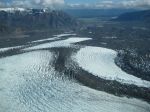
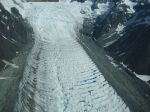
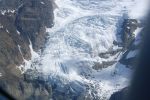
So it was at this awesome place that we decided to give our bikes a rest and take some time to soak in what the Wrangell-Elias mountain ranges had to give us. One day we took a flightseeing tour and flew over numerous glaciers. Words really can’t express their beauty. They are truly something that defies description so you must make it an absolute to visit a glacier in person during your lifetime.
A glacier’s amazing attributes make it one of the wonders of the world. A slow moving dynamo, a glacier is an unstoppable force, one that the earth itself cannot stop. Able to render solid rock from the walls of a mountain and carve new pathways, they possess incredible beauty often glowing so brightly that they are difficult to look at. When you do gaze upon them you may find them to be solid white or silver, striped, or brown/grey, completely covered with the rock and gravel they have scoured from the mountains as they have slowly journeyed past.
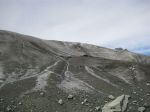
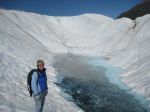
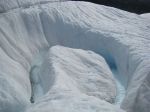
It was therefore an even greater treat to walk upon the Root Glacier for a 4 hour guided trek, where we found the glaciers not only to be beautiful, but alive. As we approached, the scene was a bit lunar like as the surface was grey and rocky with the murrain that the glacier had removed as it traveled along the mountain’s sides. However, as we made it to the top, the surface glinted and gleamed under our crampons as we walked up the side. As we crested the first peak of the glacier and investigated its surface, we saw that it indeed had the attributes of a living being. There were streams that twisted and turned, ponds of bright blue and dark azure, deep crevices and soaring ridges, all located on the body of this single glacier and all viewable during this short hike. Amazing. We stopped for a short lunch from a ridge overlooking a bright blue pond and sooner than we knew it, it was time to leave. Having been on the glacier only 4 hours, we felt cheated but at the same time honored to have witnessed its power and beauty so close and at such a personal level.
Next, we toured the Kennicott mine. Again we witnessed amazing sights but on a more human and personal level. This mine was one of the largest copper producers in the world. But producing the copper took a gigantic toll on the men who extracted the copper from the mine. The mine was truly in the wilderness and as such Kennicott had to be totally self sufficient. Rail brought in supplies and took out product, but that was about it.
You were on your own and needed to work hard to make a living. Your bunk was supplied by the company and it was a hot bunk. When you were not sleeping in it, someone else was. You worked in the mines or in the factory that separated the copper from the ore and you did it 7 days a week. The temperatures we in the double digits negatives and the heat supplied was not for the workers but to keep the machinery working. It was the lucky worker who was stationed next to the heaters that heated the machinery. If you were far from those heaters, you got the temperature the environment gave you. As we said earlier, this land required stout people.
Before we knew it, it was time to leave McCarthy and the Kennicott mine area, get back on the bikes and continue our Alaskan adventure. In the morning we would once again wait for the van beside the Root Glacier and be taken back to the foot bridge so we could make our way towards Seward where we will take you in Part 8.
I’m Going To Stop To Take A Picture (Part 3)
When you are out adventure riding, there are certain moments that beg to be recorded. The problem is that the timing may not appear to be right to take a picture or a video. You are too busy enjoying yourself, you are angry about a situation that has occurred (the 4th puncture of the day may be such a time), you may be very sad because of a sight you’ve seen or been part of someone’s plight. But the recording of such events, while at the time appearing to be too maddening, too difficult, or almost inappropriate (and there are inappropriate times I would suggest), in the fullness of time actually call to be recorded. Who will remember these times? How will these times be shared without such recordings?
Do yourself and the world a favor and record the happenings. And… once recorded, share them with others so that they too can experience what you have done, seen, and experienced and they in turn pass it on to others. Such times do are short in duration, but can be made to last forever if you just take the time to record them.
Lastly, record what’s important to you. Don’t let others tell you what is and is not important. It’s what important to you that matters. Because what’s important to you reflects who and what you are, and that’s what you want to share now isn’t it? So let’s find out who Kim and Mike are from some of their moments, but believe us, there are thousands of them that we could put here. If you’d like, send us some of yours and we’ll post them here as well.
Now come on now, send us some pictures to post! Send them to Ride2Adv@gmail.com and we’ll see what we can do. Remember, to shrink the planet, you must share yourself.
By the way, if you don’t know, click on any one of the pictures in the gallery below and it will open that picture into a full size picture and then you can click your way through the remainder of the pictures in either direction in full size.




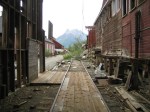

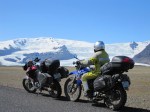

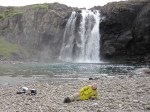



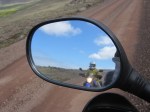


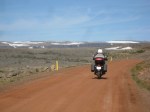




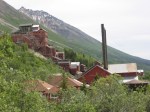

Ride2Adventure – Shrink the Planet One Ride At A Time
Transiting The Trans Labrador Highway & Canadian Atlantic Provinces (Part 2)
Having snaked our way up the side of Manic 5 we were underway for real on our TLH adventure. It had been a beautiful ride so far, but it had been an all pavement ride up to this point and we were really looking forward to a bit more challenging terrain to ride. We were about to experience some and find out what the TLH had in store for us.
As we made our way northward, the rain decreased in intensity and the low clouds began to lift a bit. We were able to see a bit more of our surroundings and enjoy the very green forests that encroached from all directions. The rain could do little to dampen our spirits as we soldiered on deeper into the forests of Labrador. Yes, we were really heading into the wilderness and we were loving it. The gravel road undulated and swooped up and down, sometimes with fairly steep grades. The gravel varied from hard packed to loose and piled, so we had to stay alert, but it was not hugely difficult riding. In fact, the rain was doing us somewhat of a favor and keeping the dust to zero.


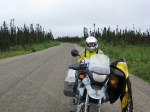


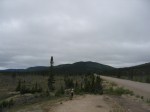


After about two hours on the road and not a single car coming from the other direction, we were really in riding nirvana. All this to ourselves, lush green surrounded us, the grey misty skies embraced us and softened all the features to a gauzy dreamlike condition. If you could ride a motorcycle and enter a trance at the same time, now would be the time to do it, it was just that peaceful. Just when we thought that we were the last two people on earth (or at least in Labrador) as we crested a hill, we were reminded that we were still surrounded by “civilization” no matter how isolated we thought we were.
To the right side of the road atop an orange pole stood tall, thin, blazing red beacon with unlit yellow and green lights. It stood there silently with another square little box counting down the minutes and seconds as if it were waiting for something big to happen. Could this really be? A traffic signal in the middle of nowhere on the TLH? Indeed it was and it was the first of its kind seen by this city boy. It was a time controlled traffic signal and it was waiting for us and telling us to wait until it counted down to zero. But it was quite strange. Ahead we could only see sodden gravel road and varying shades of green trees, for what appeared to be a half mile. We still didn’t know what it was doing there but we waited somewhat impatiently for the countdown to end and the light to turn green.
In fact, it took so long that a car pulled up beside us and turned off its engine to wait as well. It’s occupants rolled down their windows and offered us some of the nuts they were munching on and we chatted a few minutes about our trip and where were from and where we were headed. They told us that up ahead, we would find some construction where the road would narrow to a single lane and that’s why we were being held, so that traffic coming the other way would have time to pass the construction and pass us. After the allotted time had passed we would be free to go and the folks on the other end would have to wait until we had passed by the timing of the traffic signal. When the light finally turned green, we wished our new friends well and let them go first since we were in no rush to get anywhere and they were headed for Labrador City, quite a distance away.
One of the “highlights” of the trip was to pass through the vanished town of Gagnon, Quebec. Gagnon provided us with one of the most eerie feelings we’ve ever had. Gagnon was founded by the Québec Cartier Mining Company to mine iron ore at Jeannine Lake. Construction of the pilot plant began in the winter of 1957. By August of that year, the plant had processed a thousand tons of ore. On January 28, 1960, the town was incorporated as Ville de Gagnon and named after Onésime Gagnon, the first Minister of Mining in Quebec. Thereafter it grew rapidly to 1300 inhabitants and by the end of that year, Gagnon had more than 4000 residents. It had an airport, churches, schools, a town hall, an arena, a hospital, and a large commercial centre, despite being isolated and only accessible by aircraft
In 1974, mining began at Fire Lake, some 80 kilometres (50 mi) north-east. By the mid-1980s however, the mine was no longer turning a profit and the mines were closed. More startlingly, the town fully was fully dismantled in 1985. All buildings and nearly all of the streets were demolished. The town’s main street is all that remains and it became part of Route 389 two years after the town’s closure. Eerily, that section of road retains a boulevard configuration, complete with a median, sidewalks, and sewers, despite being deep in the wilderness, hundreds of kilometres from the nearest active community, It was a very strange and unsettling feeling having traveled many miles on damp gravel to arrive at a paved section of road, complete with dividers and sidewalks, and see nothing around you but brush and trees. You could only stare and wonder, “What happened to all the people who used to live here and where are they now?”
We stopped for a brief time but needed to move on since we had planned a fairly long day and had planned to bed down in were bedding down in Labrador City. As we headed further north, towards Fermont, the mining town that led to the closure of Gagnon, the road began a set of twists and turns and multiple rail crossings. Despite the fact that you are many miles from any large city, there are plenty of trains traversing these tracks and you must be very careful at the crossings to ensure that there is not a train coming. While we completed this section in a single day, three separate trains passed by us.
Another hazard of the TLH is the “dreaded” road grader. Traveling at low speeds, the transit the TLH for hundreds of miles evening out potholes and adding a slight crown to the road to assist in drainage. While this is excellent for the four wheeled variety of vehicles, it can lead to more difficult riding for the two wheel variety. The graders often leave an in or two of soft mixed soil in their wake as well as very significant mixed gravel berms that can make negotiating the road quite difficult. The graders have gained a significant notoriety among the two wheeled adventure riding community and although their wake is not generally deadly, it can bite the unsuspecting if you turn your back on them as we’ll find out in Part 3.
I’m Going To Stop To Take A Picture (Part 2)
Since I posted Part 1 of “I’m Going To Stop To Take A Picture (Part 1)” (which has been our most popular post by far to date) I’ve been mulling over exactly what constitutes “scenery”. Having been going through the selection process of many of our pictures this afternoon, I’ve found that there’s a very definite question of interpretation. Are we just talking about landscapes when we talk about scenery or can it be more? Can people be in a scenery picture or do they distract the view from the overall viewing pleasure? Well, having thought about it for a good part of the day I’ve come to the conclusion that… I don’t know.
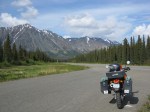
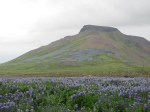
One thing I do know is that I’ve found that I have a lot of pictures that could be classified as scenery, so I’m not sure how I’m going to present them to you or how to best sum them up to you. Hmmm….. Will it just suffice to say that they recall beautiful or memorable scenes? Is that too broad a definition? I really don’t know. So here’s what I’m going to do. I’m going to show you some nice pictures and call them scenery. The only rule is that there are no people in these pictures and then I am going to let you decide whether they constitute scenery or not. Perhaps after you’ve looked at the pictures, some of you will care to comment on what constitutes a scenery picture and what you thought of the pictures I chose to post. How’s that?
Oh and a last confession. I must have as Carl Sagan used to say… “Billions and billions” of pictures that could qualify as scenery and I have not posted them all in this post. So if you are not careful, I just may post a Part 2a. You have been warned. I sincerely hope you enjoy these pictures from all over the world where we have been.
By the way, just in case you don’t know, clicking on one of the thumbnail pictures will open it to a full size picture and you can then click through the whole gallery of photos if you like.




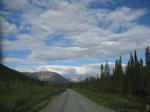


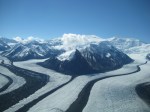

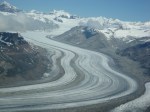


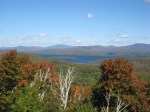














Transiting The Trans Labrador Highway & Canadian Atlantic Provinces (Part 1)
As native New England adventure riders, we were looking for a ride that would be a bit more off the beaten track but doable within the 2 weeks we had off. Something that was not your garden style ride, but something more. We wondered where we could ride that would take us off the pavement and into the wilderness a bit, but still put us in touch with some different local flavors. Something that we were not used to and would be new, interesting and exciting. After thinking about it for a while, we thought we had come up with the only conclusion possible for us. The Trans Labrador Highway (aka the TLH)! At the time, a little traveled gravel road known for its changing conditions, pea sized gravel, significant distances between towns and nice people in them. Then we thought, while we were at it, we may as well visit Newfoundland and Nova Scotia!
Done! The deal had been struck, we would leave in the middle of June and head generally northeast up through Quebec, into Labrador, to Goose Bay, where the TLH ended, hop a ferry to Cartwright, get back on the TLH and ride to Blanc Sablon (actually in Quebec) hop another ferry to Newfoundland, ride south down the west coast of Newfoundland and once again jump on another ferry to Nova Scotia, ride the length of Nova Scotia and then board one last ferry to Maine and ride back to New Hampshire. What a great trip!
The machines for this trip were a KTM 950 Adventure for me and a BMW F650GS for Kim. Although we planned to stay in hotels or B&Bs each night, we loaded them up with some extra supplies and gear in case of breakdown along the TLH. We had emergency food, water and shelter and fuel just in case, and we were still loaded within reason.
So off we went on a bright and sunny afternoon headed towards Magog, Quebec. Once reaching the Canadian border, signs in both English and French reminded us that we were indeed in the French speaking province of Quebec. Ahh… a different culture flavor to enjoy. As the day wore on, the skies turned a bit more ominous, but luckily for us, we made it to our first stop completely dry and were able to enjoy a nice French Canadian dinner. Yum! We hit the rack fairly early in hopes of getting an early start the following morning. We hoped that the good weather we had encountered all day would continue into the next. However, we were not so lucky this time and the skies decided to open, shedding their grey and misty burden upon the surrounding green landscape. On went our rain gear and we made our way north. All morning we encountered rain and wind, but by the time we had made it to La Malbaie, the rain had stopped and the sun occasionally peeked out between thick layers of heavy grey clouds.
We continued on in increasing sun and drying roads. By the time we had made it to Baie Comeau it was downright sunny. A few miles later and we were ready to board our first ferry of the trip, a very short jaunt across a river but the only way across it. There was a short backup of cars and trucks and everyone was patiently waiting their turn. While waiting, we chatted with several people who wanted to know about the bikes and where we were headed. When we told them we were about to traverse the Trans Labrador Highway, many were impressed, some wished they were coming along and all were very friendly.
In the increasing sun, we passed our first of several large dams that would mark our progress along the TLH. All of these dams are named with the precursor name “Manic” short for the Manicouagan reservoir that feeds the dams managed by Quebec Hydro. These dams are very important powering large portions of eastern Canada as well as the Eastern United States. We did a bit of the tourist thing and stopped for a few pictures at Manic 2 and Manic 5. All of the Manic dams are impressive structures, the most impressive being Manic 5 where the gravel of the TLH begins. We had hoped to take a tour of the inner workings of the Manic 5 (more formally known as the Daniel – Johnson dam), but we were two days early for the start of the tour season, so we missed out.
By the time we reached Manic 5 and the Energy Hotel where we would stay for the night, we were pretty tired so we unloaded our gear and piled it into our converted mobile home room. We walked past several other converted mobile home units and into the small cafeteria for some dinner. We noted that all of this was created not for the tourist trade, but to put up traveling workers who service Manic 5. As we sat and ate our cafeteria food, we looked around and noticed that we were the aliens, the outsiders. The real inhabitants of this place were the workers who kept the beast which was Manic 5 alive, fed and healthy. We were merely outsiders, observers, not doers involved in keeping this mammoth beast alive which in turn made so many other people’s lives easier and literally, full of light. It made me feel small. However, in little over an hour, we had finished our meal and we walked back to our room in gathering darkness and mounting drizzle.
As morning came, it was raining and raining hard. But the TLH called and we were anxious to be under way and start the beginning fo the gravel portion of our adventure. We loaded up our bikes and made our way over the last short portion of pavement. Prior to arriving on the gravel, you weave your way past several corners as Manic 5 looms in front of you. Several giant arches equally spaced with a single giant arch in the middle face you looking like tressels to a giant bridge. As you get closer, the immensity of the structure strikes you, this beast is large and it is powerful. Its size and power become more evident as you ride the road that climbs beside its concrete face.
Suddenly the road turns to gravel and it is steep. You make your way up the road and as you make it to the top on this new to you gravel surface, you can look down and see that you have climbed over 700 feet from whence you started. This dam is indeed spectacular. We stopped for a few pictures and began our TLH adventure in earnest. We’ll tell you more about our journey in Part 2.
Alaska – Gravel, Grandeur & Goofy Grins (Part 6)
We enjoyed being in Dawson City so much that time was vanquished much more quickly than the setting of the sun in Dawson’s 21 hours of daylight. Suddenly it was time to leave this wonderful place. With quite a bit of disappointment, we the loaded the bikes and headed for the ferry and back up the mountain to the US border via the Top of the World Highway.
The trip to the border was fairly easy going with great scenery, good gravel and bright sun. We did unfortunately encounter some people in motorhomes who were driving recklessly. Very slow up the steep grades they would not let you pass and when you finally did pass, they would come down the steep grades very fast at the risk of burning out their brakes and tailgate until the next upward grade. Other than the motorhome issue, you couldn’t ask for a much nicer trip to the border. Once there, we were greeted by the residents of the town of Poker Creek Alaska, population 2. The residents? The two border guards that live at the house on the border while the highway is open. They were very friendly and even assisted us with the motorhomes we had encountered on the highway. The let us through very quickly and determined that the motorhomes merited a much more significant inspection. Ahhh… payback. Thank you guys!
Past the border we headed back toward Chicken and made a stop at the Chicken Creek Cafe for lunch again. We met a few travelers while there and discussed off road riding and our journey so far. Many expressed a desire to ride with us or make the journey on two wheels instead of four, so they too could enjoy the adventure as we had been doing. They all said… “Someday.” We were so glad that we had made “someday” arrive for us.
One of the travellers asked us which of the bikes was better and I remarked that they were both good bikes He said he thought the KTM was probably the better bike because it had glasses. I wasn’t sure what he meant until I turned around and looked at the headlights of my KTM and then I saw what he meant. The lens covers on the KTM did indeed look like glasses! (see pictures). Very dirty glasses, but glasses nonetheless.
On the way out of Chicken, we stopped to see Chicken’s own dredge, the Pedro dredge. It was being restored and was smaller in size than dredge #4 in Dawson, but you could get much closer to the Pedro dredge. We walked around and took a few pictures and once again we were reminded of the toiling that took place over a hundred years ago in search of gold.
After the pictures, it was time to get moving again so we could get to our hotel for the night at Tok. As we had related earlier, for us Tok did not represent anything special so it merely became a waypoint and a disembarkation point for our next stop at McCarthy, Alaska. McCarthy had special allure to us for numerous reasons. First, while we were researching this trip, we found the Kennicott Glacier Lodge which is located directly beside the Root Glacier that we intended to walk and which was only a short hike from the old McCarthy Copper Mine which we also intended to tour.
Having found the Kennicott Glacier Lodge with all the surrounding areas of interest, we excitedly called to make reservations. We told them we would be arriving on motorcycles and the assistant suddenly became very concerned. Did we know that they were located at the end of a 60 mile gravel road? Why yes, yes we did, and that was precisely one of the reasons we had decided to come and visit them. With a bit of hesitation, the attendant booked us and were all set to go to McCarthy. We couldn’t wait to get there.
After a few hours sleep in Tok, we tried to get an early start but we ran into two separate mechanical problems. First, one of the pannier bolts had broken on the KTM and the bolt was broken off inside the mount. Damn! There was no way for me to get the broken bolt out of the mount myself. The first thing to do was to totally unpack the bike. Then find a shop where I could get an extractor to remove the bolt. Ultimately I found an ATV shop where I spent several hours disassembling the pannier mounts so we could get at the mount to extract the broken bolt. Once we had extracted the bolt, I reassembled the pannier mounts and headed back to the hotel. By this time it had started raining. Nice. It was a short ride to the hotel where Kim was patiently waiting. We rushed through loading the bikes quickly as time was wasting.
I fired up and jumped on my bike and immediately knew something was wrong. The bike felt all mushy and it felt like I was riding on iron rollers. It was immediately clear what the problem was. I had a rear tire flat. Damn! Again! But the tire still had enough air to get back to the ATV shop without ruining the tire. Once there, we checked the tube and found no punctures. Now what? Believe it or not, it was just that the valve core was loose. Double damn! But it was an easy fix and another short ride later I was back at the hotel and packed for the ride to McCarthy.
As we made our way to McCarthy first on paved roads to the Kennicott mine with its rich history as the biggest copper deposit ever discovered, our anticipation and excitement grew as did the sight of the Wrangell – St. Elias mountain range and the glaciers it held. There were beautiful vistas filled with mountains and trees and nothing else. They continued to grow and grow as we approached, but forward motion did not seem to exist. We knew we were traveling at around 50 mph, but the size of the Great Land and the distance to the mountain ranges nullified any feeling of forward progress. We felt suspended in time and space. Although we were moving, the landscape and the surroundings really didn’t change other than to witness the increasing size of the mountains in front of us gradually got closer. Mountains changed from smallish bumps to taller peaks and finally to towering monoliths directly in front of our eyes.
By 5:30 PM we arrived at the turnoff of the pavement to the beginning of the gravel to get to Kennicott. We’ll take you there in Part 7.
Alaska – Gravel, Grandeur & Goofy Grins (Part 5)
As we had feared, our time in Dawson was quickly nearing its end. We had originally planned to ride the length of the Dempster Highway to Inuvik. But as our time waned, we knew we could not accommodate such a journey. Yet we were still determined to see more of the surrounding area and at the very least take a brief ride onto the famous Demptster Highway. It was an easy pavement ride to the Dempster in bright sunshine and our spirits rose even further just as did the fluffy clouds in the sparkling azure Alaskan sky. When we did reach the Dempster it was in marvelous condition. We had heard horror stories about how treacherous it could be with any amount of rain but we were indeed lucky as the road was hard and smooth and fairly dust free. If it weren’t for the spectacular scenery, in its present condition, the road was literally a gravel high speed highway. But we were in no rush and the sights were far to beautiful to speed by without taking notice.
So we dawdled along admiring the towering mountains often covered with beautiful green trees of differing varieties and greenery too vast to describe. Although they were often very green, sometimes they were barren in places and the inner core of the mountain could be seen. Hard stone of differing colors, greys, pinks and blues appearing like the bones and sinew of the mountain made itself known . Without trying to, the underlayments told the story of the mountain’s life. Soft green trees and greenery supporting all manners of life existed at the surface, while just below, cold stone lay dormant holding the living above its head. Truly, “The Great Land” is a master showman; showing you how amazing the interlocking puzzle of nature is. Everything is connected. Everything.
We rode about 60 miles up the Dempster and stopped to have a lunch by the side of the road. For some reason, our bag lunch tasted even better than usual in the beautiful surroundings. So after munching down a sandwich, some nuts and an oreo cookie or two, we decided it was time to turn back to Dawson. It was very strange, but travelling in the opposite direction was like taking another trip. It looked like different scenery. Were we sleeping on the way north? It was fantastic, a two way treat of a ride. We couldn’t explain it. The mountains were beautiful, the rivers that ran beside the road had a different character, everything seemed new. I felt like I was a kid at a carnival just getting off a ride and heading to the next. It was that kind of excitement. I was a bit drunk on it. I was having more fun than I could remember in a long time and my inner kid had just emerged. What a feeling.
At one particular point we decided we just had to have a picture. So we pulled off to the side of the road near a small stream in front of a mountain. I got a pretty nice shot of the bikes with the mountain in the background. Then Kim said she wanted a picture with me in it. So off I went to get into the picture. We wear intercoms so we can talk to each other on the bikes and while Kim was lining up the shot, I asked her through the intercom “Kim, are you sure the bike’s mirror isn’t in front of my face?” “No, it’s ok” came the speedy reply and she took the picture.
Another thing Kim likes to do is take a series of pictures of closer and closer zooms, and this series was no different. So as she focused for the second picture, I still thought my face might be covered by the bike’s mirror. “Are you sure that the mirror isn’t blocking my face?” “Yes, I’m sure”, came the reply and “click” went the camera. Finally, it was time for the third and final shot and I really thought the mirror was in the way of my face. Kim, really, are you sure the mirror is not blocking my face?” The only answer was the “click” of the camera.
So when we reviewed the results of this little picture taking opportunity, this was the result.


Love is indeed blind.
As we finished up the picture taking, another rider was riding his way north on a BMW F650GS towards Inuvik, our original destination.
He stopped and we chatted about where he was headed and said that he was indeed headed to Inuvik which was about 400 miles away. I asked him if he had any extra fuel and he said that he did not. When I asked him when he had last filled up he said he wasn’t sure. Kim and I were astounded. Here we were in the Canadian Yukon, in significant bear country and this gentleman absolutely didn’t have enough fuel to get himself to Inuvik and he may not have had enough to get himself to the next town at Eagle Plains over 100 miles away. Since the bike I was riding carried 7 gallons of fuel I offered to give him some fuel. Luckily, he accepted and I was able to give him over 3 gallons of gas! That being the case, it would have been problematic for that gent to reach Eagle Plains. Boy were we glad we had this chance meeting.
So feeling we had done our good deed for the day we headed back to Dawson City for dinner. We had promised ourselves a nice dinner at one of the premier restaurants in town. Oh boy was it nice. The presentation was marvelous and the taste wonderful. It was a splendid way to top off a beautiful day of riding. After dinner, we did a bit of walking around town to drink in all that Dawson City represented. With sunrises around 3:30 in the morning and sunset around 1:00, there was a lot of sun for the day. I for one, did not miss the night and could have stayed up for what seemed forever during our stay in the Dawson City area.
As great as Dawson City is, there’s even more to be seen as we head back southeasterly towards McCarthy, Alaska which we’ll tell you about in Part 6.
Alaska – Gravel, Grandeur & Goofy Grins (Part 4)
Having seen Dawson City’s colorfully painted downtown town district calling to us from above, we were excited to finish the rest of our descent and take it all in up close and personal. We jumped back on the bikes and scooted quickly down the rest of the mountain until we reached the Yukon River and the free ferry across. There was a short line of cars and trucks waiting for the ferry to make its way back across the river and pick us up. But before long, the ferry arrived and we were making our way back to Dawson City.
After a brief ten minute crossing, the ferry ramp came down and we had landed in Dawson. Suddenly we found ourselves in a wild west town of the 1800s. The streets were all dirt and the sidewalks were not sidewalks but elevated wooden board walks. Two story gayly painted buildings stood in front of us with hand lettered signs. There wasn’t a chain store in sight. There was even a horse drawn wagon. From our surroundings, I thought I could hear spurs jingling on my boots as we rode.
As we rolled into the center of town, we found the town hall/information center. It too was fronted by a dirt road and elevated wooden boardwalk and we decided to stop there and pick up some information on Dawson and the precise whereabouts of our little hotel. We pulled off the dusty roadway and parked. Kim dismounted and I was about to dismount when a bearded gentleman approached offered his hand and said, “You must be Kim and Mike.” We were flabbergasted. Here we were, in a tiny town in the Canadian Yukon literally almost 4000 miles from home and a guy we’ve never seen before in our lives picks us out just as we are getting off our bikes and says hello like he’s known us all his life. We love adventure riding.
Ahhh… Yes, yes we are, we mumbled or something to that effect. He introduced himself as Tracy. Tracy was the person that the couple at the McKinley View Lodge had told us that they wanted our email address for. He had emailed us previously and said he hoped to meet us at the Dust to Dawson (D2D) gathering, but wow, this was something. We both hadn’t even gotten off our bikes yet! We hit it off immediately and Tracy, Kim and I spent quite a bit of time together at D2D enjoying the events, meals and even a ride or two or three. By the time we had to say goodbye, we knew we had become steadfast friends. In fact, we are still friends to this day even though thousands of miles separate us from Tracy and his wife MaryLee. But we haven’t let that stop us, we’ve taken the time to correspond, and this past summer rode a good portion of the Trans American Trail together.
So when we tell you that adventure riding means more than just riding a motorcycle, think about this. Two people from New Hampshire have a chance meeting with a couple they’ve never met at a lodge near Mt. McKinley. This couple asks us for our email address to give to their friend who rides motorcycles. That friend tracks us down in a town in the Canadian Yukon and we hit it off so well that we spend three days together. That relationship is so cemented by the passion of adventure riding that the long distance relationship is maintained for four years and two couples then get together in Tennessee and ride across the country together mostly off road. I think you’ll agree that there aren’t many activities that provide the zest for life and yearning to be together to explore than adventure motorcycling.
But let’s get back to Dawson City, the D2D event and what can be found around Dawson. For a pretty small town, there is much to be found in Dawson especially during D2D. For those of you who may not be familiar, D2D is an adventure riding event hosted by members of AdvRider.com. It’s a gathering of like minded adventure riders from all over the world. Adventure riders are indeed shrinking the world. While we were there, there were riders from Europe and Australia. Planned events include group rides, a riding skill challenges and a large sit down meal. It’s just a terrific gathering.
But Dawson isn’t just about D2D. They also have some interesting historic venues. They have recovered and recreated one of Jack London’s actual cabins. It’s a tiny structure with a sod roof. It wouldn’t be big enough to be considered a one bedroom apartment today. When Jack lived in it, he shared it with at least one other person and sometimes more. Outside was an elevated and enclosed perch where food and other supplies were stored lest you attract bears into your living quarters. Every time you went to get food, you had to climb that high tree and get it. It was difficult to imagine all the hardships of dealing with the lack of running water, electricity, and just surviving the environment, never mind the addition of the absolutely challenging and unrelenting Yukon winter. The people of that era were the true examples of pioneers. To survive in these conditions, these people had to be ever stout and unbreakable of heart and mind. Some became rich, others bent or broke returning from whence they came and others unfortunately just perished.
With the conditions being so difficult, you may be asking yourself, why would anyone travel to such difficult climes? It was the lure of wealth. Gold. It was reported all over the lower 48, that gold could be found lying at the surface in the areas near Dawson and all one need do is travel there, stake a claim and riches would soon be theirs. So it was that Jack London was lured to Dawson and so it was that gold mining companies were lured as well. And they brought great machines at great expense. Huge floating machines called dredges capable of swallowing vast quantities of earth quickly. Many large iron buckets were suspended from a boom and they rotated one after another, endlessly 24 hours a day, gulping the earth from swamps, ponds and rivers. These machines, built more than 100 years ago, were so well designed and engineered that they extracted more than 95% of the gold that entered them.
In consuming the gold, they also consumed the men that operated them. No grease or oil was used in their operation for fear that the gold would be lost in the sifting process, as such, the metal on metal grinding sound was abominable. Men lost their hearing. There were little to no safety considerations and men were often injured in their operation and merely replaced with another man. The men worked in muddy swamps in the summer and as if to taunt them, extreme sub zero temperatures in winter. But there was gold to be found and this ensured a steady stream of people willing to try their luck to become instantly wealthy. This ultimately is the story of Dawson City.
Although Dawson revolved around gold, there’s more to talk about and we’ll tell you in Part 5.
You Meet The Nicest People On A…
Many years ago (1962 actually), Honda introduced the concept of riding motorcycles to “everyday” people with an ad campaign that featured the slogan, “You meet the nicest people on a Honda.” While that might be true of Honda motorcycles, Kim and I have found that Honda’s ad campaign slogan really is an anthem for all of motorcycling; and are we ever glad it’s the case.
Through our journeys and we dare say a few adventures, we have met the most amazing people and made most endearing and lasting friends. Other friends have come and gone, but there is something special about those friends who we have made having ridden with them or having met as a result of a ride to somewhere.
Take for example our trip to Labrador. While we were visiting the very small town of Port Hope Simpson which had only gravel roads and one means of lodging, the phone rang. Kim and I looked at each other bewildered. “Who could be calling us in the middle of Labrador?” I gingerly picked up the phone and a happy voice on the other end said, Hi Mike, this is Dave Noel. You and I have been corresponding on the Ride the Rock website, I came by to say hi. Dave had just ridden 25 miles of gravel to say hello to strangers he had been having email conversations with. After a nice visit at the lodge, Dave rode home and the following day we visited him at his house and met his family. We’re still friends to this day and we still correspond.
Or how about the time we were on a ferry from Newfoundland to Nova Scotia? I was posting about our trip to Newfoundland when I received an email from a stranger who invited us to ride with him if we were willing. In return, he’d show us some of his favorite back roads. Who were we to refuse? We met Joe Treen at a local restaurant and we were off for an excellent day of riding. Since then, we’ve gotten together to ride a number of times and Joe has come to visit and stay at our home in NH.
Perhaps we should tell you about our chance meeting with a couple at a restaurant in Alaska who told us they had a friend who rode motorcycles and that they’d like to give him our email address. Of course we said yes and ultimately we met Tracy and his wife MaryLee. Since 2008 we’ve been friends and we were even lucky enough to get time off together last year to ride a good portion of the Trans America Trail together.
Maybe we should tell you about our trip from Pucon, Chile to Ushuaia, Argentina. On that trip we travelled with Tavo, Leo, Andrew, Bjorn, Paul, Matt and Louise. We’ve only lost touch with two of them. We correspond with them fairly often. But why don’t you meet up with them more? Well, there’s a bit of a geography problem now. You see, Tavo is from Columbia, Leo is from Germany, Andrew is from England, Bjorn is from Norway, Paul is from Australia and Matt and Louise are from…… Cleveland.
As to the non-riding people we have met, we can’t tell you how they have effected us and us hopefully them. Almost everywhere we stop, the bikes are a conversation item. Where are we from, where are we going? What’s it like to ride off road? What’s it like for Kim to ride the terrain she rides? Isn’t it hard to do? We always tell them that it is a very fulfilling thing and one of the best parts is meeting people like them. They usually glow with comments like that and in turn they share themselves with us. It’s wonderful.
One story stands out in my mind. It was on our Labrador trip. It was fairly early in the morning and I was packing the bikes in the rain preparing to board the ferry to Newfoundland. It was dank and dreary and the grey ocean was topped with whitecaps. Nearby a tour bus idled waiting for its passengers to board.
As I was finishing packing an older gentleman approached and quietly watched for a while. He was wearing a clear raincoat and a yellow Gloucester fisherman’s hat. I noticed he was wearing a Cessna belt buckle and I could tell that this man had had some adventures of his own. After a while, he walked a bit closer and asked where we were headed and where we had come from. I told him that we had ridden from our house in New Hampshire and we were headed to Newfoundland. We chatted a bit about the trip so far and what the Trans Labrador Highway had been like. While we stood there in the rain, he looked me in the eye and looked over to the bus he would later board and he said, “I wish I was traveling with you.”
Ride2Adventure – Shrink The Planet One Ride At A Time
Alaska – Gravel, Grandeur & Goofy Grins (Part 3)
We left the Tangle River Inn and made our way easterly towards Tok. We were in and out of rain showers and frankly our arrival was a bit anti-climatic. Tok is a decent sized town, but is not all that distinctive. Perhaps what made Tok distinctive was the Westmark hotel which contained a slew of busses carrying cruise ship passengers headed for another point of embarkation. All those people jammed together and they really weren’t seeing the real Alaska and its people. What a shame.
We stayed only overnight and headed out first thing in the morning north-easterly towards Eagle, year round population 180. We knew that the trip to Eagle was a dead end cut off by the Yukon river, and that we would have to re-trace our tracks, but we thought that the surrounding roads and terrain looked pretty interesting so the trip was worthwhile. There were mountains and gravel roads to ride and 180 people to me so that seemed like fun!
Shortly after hitting the road the rain began. Nothing ridiculous, but on and off showers as we made our way along the paved portion of our day’s trip. Sooner than we knew it, we were on the gravel and making good time. And then the skies opened up. It was as if one of Alaska’s glaciers had burst and let loose the millions of gallons of ice melt water that had been contained for years. Visibility dropped to near zero and the temperature dropped as quickly as the falling rain. There was little else to do but stop and put on rain gear. While we unpacked our gear from our bikes, a ten wheeled dump truck traveling in the opposite direction stopped and the driver rolled down the window.
He had news. Just ahead, he said, they were repairing the road and laying gravel down. Big gravel, in 1 and 2 inch chunks, about 2 inches deep. Not to worry though, the gravel was only about a 3 mile stretch. “Marvelous, just marvelous”, I thought. Then he said that the gravel wasn’t the real issue. They were laying the gravel because the road had turned to mud and they were dumping the gravel on top to make the road surface hard enough for travel. “Wonderful, just wonderful”, I thought. Not to worry though, the mud was only a mile long though. “Crap”, I thought.
Oh well, we came for some adventure and adventure we were going to get. So on we went, slowly making our way through the pouring rain on asteroid size chunks of gravel and sloppy mud. But when all was said and done, we made it through with flying colors with Kim riding the gauntlet like a knight who’d won many a match with nary a slip. She did indeed pull off a spectacular ride.
For all this testing, we were greeted by the über small town of Chicken (its real name is Chicken Creek). It is said that it Chicken was so named because the settlers found that the surrounding countryside was full of Ptarmigan. However, no-one could spell Ptarmigan, so they decided to name it Chicken.
While passing through Chicken, we stopped at its epicenter, the Chicken Creek Cafe and the Chicken Creek Saloon. In a strip of attached wooden buildings, they served home cooked food and bottled liquor. The food was excellent especially considering there is no running water at all. They hand pump all their water for cooking and cleaning and there are no flush rest rooms. If you need to use the facilities the outhouse is out the front door to your right.
But by the time we finished our meals, we were well rested and the rain has stopped to a drizzle. Ahh… It was time to make our way to Eagle and get a good night’s sleep. When we arrived at Eagle it was getting late and we checked in and headed to the only restaurant in town which was right on the Yukon river. It was a good meal and only made us more sleepy.
The following morning we had some time to meet our innkeeper and talk about life in Eagle and what ever else she could think of. It turns out that she was not a native of Eagle but had been a school teacher in Wisconsin. She had developed a pen pal relationship with a man who told her he lived in a small town in Alaska called Eagle. After about a year, he invited her to come out and visit him, she did and found that his home had no running water and no central heat. But she fell in love with Alaska and ultimately the man and never returned to Wisconsin.
We stayed only one day in Eagle and in the late morning headed towards Canada and the Yukon Territory town of Dawson City. We had an appointment to attend ADV’s Dust to Dawson event. ADVers from all over the world would be in attendance and we were looking forward to meeting other adventure riders from various corners of the planet.
Back we rode over the same gravel road from whence we had come and just before getting to Chicken, we made the turn to make our way to the Canadian border and ultimately onto the Top Of The World Highway. Approaching and crossing the border was pretty anti-climatic. The Canadian border is in the town of Little Gold Creek. Its residents? The border guards that live at the house at the border crossing and no-one else. While there, they asked appropriate questions and sent us on our way.
Then we were off and traveling the Top Of The World Highway. The views were great, but for some reason we were not awed. The road surface changed back and forth from gravel and pavement which made the ride a bit interesting, but for some reason, there were an abundance of motorhomes and vehicles with trailers on the road despite being fairly in a fairly isolated area. It became a bit frustrating as the motorhomes were very slow going up the very big hills we encountered and very fast coming down sometimes traveling uncomfortably close to Kim as she descended the hills.
But after about an hour we started a gradual descent and approached the town of Dawson City. Coming down some of the final hills, we came to a clearing and could catch a glimpse of the city we were about to visit. We could see the town center and it was painted in bright, lively colors that beckoned to us from the valley below. The Yukon river continued its lazy flow in front of us, for now cutting us off from the delightful little town. But we were only a couple of miles and a free ferry ride away from 3 days of fun in Dawson which we’ll tell you about in Part 4.
GeigerRig Hydration Systems
You’re hot, sweaty, tired, thirsty and in the middle of no-where. You need a drink. So does your riding buddy or buddies. Now what? You’ve made an unfortunate mistake and fallen off your machine, are a bit bloody and need to wash some grit out of that abrasion. Eww… what to do? You need to carry some gear for the day trip or a bit longer trip but you don’t want to weigh down the bike with tied on or fully mounted gear. So how can you solve all of the above equations? Is there a simple, single solution? Well kemosabe’, to this writer, there is.
Enter the Geigerrig. A backpack with a built in hydration system. You may be thinking, so what there are a bunch of hydration systems out there, what’s makes this one different? Well among other things, this one is different in that it is pressurized; pressurized by you by means of a small, attached bulb on the outside of different sized backpacks. So in the scenarios discussed above, your pressurized Geigerrig works like this…
- You’re hot and sweaty, cool off by squeezing the end of the drink tube and squirting the liquid all over your body. Ahhhhh…. so nice.
- Share a drink with your buddies… your buddies squeeze the end of the included drink tube and squirt the liquid into their mouths. No nasty exchange on a single mouthpiece.
- Dirt, sand, mud in your abrasion… squeeze the end of the included drink tube and squirt the liquid onto the wound and wash as necessary
- Need to carry gear… put it in the backpack of the hydration system.
Now if all this seems like an advertisement for Geigerrig, it’s not. All we can say is that we used this hydration system on our Trans American Trail ride this summer with temperatures often over 100 degrees every day. The value in having cold water during the day (we filled the hydration pack with ice cubes and water in the morning) for drinking and for cooling off was immeasurable. For example…
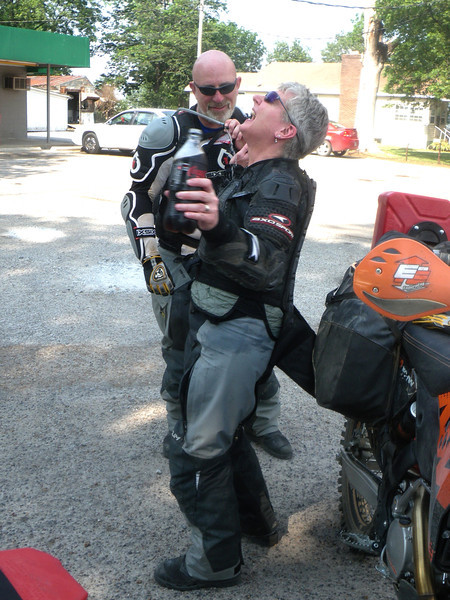

Pretty chilly water still squirting late in the afternoon on a 100+ degree day.
We can’t tell you how important the Geigerrig was to staying hydrated and cool enough to finish the trip.
As for the details of the rig, the one you see in the picture is the 1600. It accommodated plenty of gear, it was large enough to handle a rolled up jacket, maps, some tools and other goodies needed. It attached easily and securely with no flopping around noted. There are many pockets to segregate your gear so if you pack your gear systematically, you can do so and know exactly where to find your items.
Filling the “hydration engine couldn’t be simpler. Unhook it from the interior hook, slide off the clip from the hydration engine container, unfold the bag and open. Fill the engine and reverse the process. Easy. Even with the engine filled with liquid, there was still plenty of room in the 1600 backpack.
However, all was not sunshine and roses. One distinct shortcoming was the length of the hydration tube. It was too short to drink from while riding and wearing a helmet. This is a major oversight in my book and Geigerrig may have addressed this by now, but it is a very unfortunate and important shortcoming. Drinking on the roll can be very important for those who ride long distances or who are in environments where stopping constantly is not an option.
Still all in all, I would give the Geigerrig an A-. Frankly its a piece of gear that no-one should be without. For more details on the Geigerrig, visit their website here.
Arai XD4 vs XD3 Helmet Initial Impression
I’ve had a little time to ride in Arai’s XD4 and have an initial impression of it as compared to the Arai XD3. On a sunny Vermont day, we were able to put in a little over 100 miles mostly on pavement with some dirt and gravel and a tiny amount of slimy mud left over from the Vermont mud season. With temperatures in the high 30s to low 40s, we did everything from low speeds to some higher speed twisties, so we had a fairly good day and mix of conditions to get initial impressions.
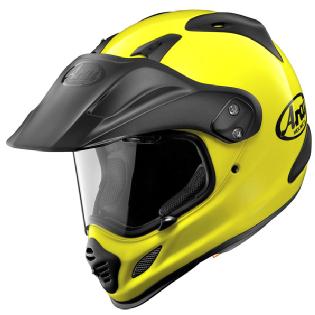
Arai XD4

Arai XD3
For me, both helmets seem to have the same helmet shape shell and the fit was essentially the same between the two models. However, for the XD4, Arai has redesigned the cheek pads. Not only are they a slightly different shape and size, but the cheek pads supplied as original equipment with the helmet are apparently now 5 MM thicker than with the XD3. In the size M that I purchased new years ago, the stock cheek pads were 20 MM. Now, in the XD4, the stock cheek pads are 25 MM. Frankly, the 25 MM cheek pads are probably the best fit for racing and 100% safety, but in return they give you that squished face, kissing fish face feel and look. Not the most attractive and comfortable way to ride.
So if you don’t like the look and feel of a small aquarium fish, never fear, in the XD4 Arai has thoughtfully included an easy peel 5 MM layer for the cheek pad. You simply just remove the cheek pads, then the covers and carefully remove the clearly marked 5 MM layer. I chose to go this route and if I can do it, anyone can. Then just put the cheek pad covers back on and insert the cheek pads back in the helmet and you are ready to ride, newly minted 20 MM cheek pads and all.
Out on the road, one of the things that the XD line of helmets provides is excellent visibility. The XD4 continues this tradition with excellent visibility with a wide viewing port, again big enough to wear goggles in if you wanted to remove the face shield. Another thing that the XD series does well is flow air and the XD4 does not disappoint in this area either. We did over 100 miles yesterday in temperatures ranging from high 30s to low 40s (F). You do get a good amount of air around your neck and lower chin so if it’s really cold, you’ll want to make sure you have some way to block the air in theses areas. However, with closed vents, air flow was blocked off and no cold drafts were noted, so I’m going to say that the seals are apparently good since the XD3 flows a decent amount of air through its vents when moving. The vents on the XD4 are substantially larger than the XD3 and they portend much more ventilation than the XD3. I’ll update this when we get into warmer weather.
The shield was susceptible to fogging in the cold, but it was easily dispatched with just a slight crack of the visor. Nonetheless, I’d suggest an insert of some sort. Kim and I use Fog City but there are others out there like Pinlock that Arai shields are set up to use.
The visor on the XD4 has been redesigned, is smaller and is claimed to be more aerodynamic than the XD3. We did ride at a brisk pace during the day, but nothing approaching race speeds. I was riding a KTM 990 Adventure and if you are familiar with that machine, it has a tiny windshield. At 5’9″ sitting behind the stock KTM windshield, I did not notice any substantial increase or decrease in buffeting. If there is a benefit, it must be more recognizable at speeds over 80 MPH.
Weight is claimed to be down on the XD4 compared to the XD3, but frankly to me it’s not that noticeable in riding. Perhaps over a very long day, the lighter weight would be more noticeable and less tiring, but over a mere 100 mile jaunt, not much difference was noted. I’ll add that Kim carried the helmet a bit and claimed it was lighter when compared to her XD3 and she’s a pretty good judge of these sort of things.
So there you have it, an initial impression of the XD3 versus the XD4. Once the weather heats up a bit and we have a few more miles under our wheels, we’ll update you with a longer term update on living with the XD4.
Ride2Adventure – Shrink The Planet One Ride At A Time
Sometimes Adventure Is Not So Far Away
As we crested a hill in nearby Dunbarton, NH, we spotted a police cruiser on the opposite side of the road in perfect position to nab passing speeders. Damn, was he first thought that crossed my mind as I looked at my speedometer to find that I wasn’t speeding and that I needn’t worry. But it was enough adrenaline to make me slow down considerably and look more closely at the police cruiser that we were now slowly approaching.
It was a Dunbarton cruiser all right, but upon closer inspection, it was a 1970s era Chevrolet Chevelle cruiser, with two bubblegum blue lights on the roof and an old bee hive siren on the hood. In addition it had an old style whip antenna attached to the side of its rear fender. So as Kim and I slowly rode by, I knew that something was up.
Curiosity was eating at me. What’s a 70s era cruiser doing on the side of the road running radar? They say that curiosity killed the cat, so I guess that I’m lucky that I’m not a cat. About a mile down the road, I signaled for Kim to stop and turn around so we could go get another look at that old cruiser. We reversed course and as we approached we could see that there wasn’t anyone in the cruiser. So naturally, I signaled Kim to stop.
We turned off our engines and both got off our bikes. It was a 70s era cruiser all right and it was in perfect shape. In fact, it was gorgeous, it had been fully restored and I was impressed. As we walked around the cruiser admiring its restoration a gentleman walked out of the driveway of the house from which the cruiser had been parked. His name was Len and he had restored the cruiser himself.
Len told us that he like to restore different kinds of vehicles and invited us to see the other ones he had restored. So as we walked past his high hedges into his front yard, we saw his large oversized garage with a sign that read “Toy Box Garage” in whimsical lettering. As we walked inside, we were in for a treat!
Not only did Len have restored vehicles including old Packards, 1 1/2 ton Army trucks, jeeps, 1930s era farm trucks, an aluminum engined Oldsmobile and tractors, but he also had the most amazing collection of gas station paraphernalia including pumps, signs, you name it, he had it. It was a thing of beauty.
It turns out Len had retired and he restored old vehicles as a hobby. He now donates his time and his vehicles for town events to surrounding towns for parades etc. He and his wife Beth both helped out as much as they could and are well known in their communities for donating their time and energy for free.
Before we could leave, Len gave us some parting gifts from his vast stock of paraphernalia he had collected over the years. He invited us to come back any time and to bring our friends. So when we had a world traveller come and visit us on his BMW from Australia, we could not think of a better local place to bring him. Once again, Len rolled out the red carpet and our newly minted Australian friend left with gifts from Len and Beth of expired Massachusetts and New Hampshire license plates that he could take back to Australia and tell his friends about.
So not to far from our home, less than 20 miles in fact, our short adventure ride enabled us to find and share our friendship with Len and Beth with our new Australian friend Geoff. Through this sharing, on a brief 20 mile ride, we shrunk the planet a little more for a person that came from half way around the Earth. What more could anyone ask from adventure riding.
Ride2Adventure – Shrink The Planet One Ride At A Time
Alaska – Gravel, Grandeur & Goofy Grins (Part 2)
As we said earlier, we stopped at the McKinley View Lodge where we were in for a special treat. After a brief lunch we learned a bit about the history of the lodge and its progenitor, Mary Carey. Mary was one of the first female pilots to fly an aircraft over Mt. McKinley and she also built the lodge with some of the tools and heavy equipment you see in the slideshow. Google Mary for she was a very interesting woman.
But we were in for a more interesting treat when as we were leaving, we struck up a conversation with a couple who noticed our NH plates on our bikes. After telling them about our journey and where we were headed, they asked if we would mind if they shared our email address with one of their friends who also motorcycled around the area. Of course we agreed and we were on our way.
We continued our way towards Cantwell in a dreary overcast, hoping that the cloud cover would lift a bit so we could see Mt. McKinley in all its glory, but persistent rain showers pestered us as we moved north. Although at times the clouds did appear to break a bit, they never fully opened and we did not get to see McKinley. But as the day progressed, it did brighten and we were treated to some breathtaking scenery.
When we rolled into Cantwell, it had pretty much cleared. It had been a long day of riding and we were pretty tired. We checked in to a small off the road hotel and asked them for a place to eat. It turned out that the closest place was called “The Perch” and was about 15 miles away. So we jumped back on the bikes for another ride which turned out to be quite beautiful and to top it off, the dinner was quite awesome as well.
After a long and sumptuous dinner, we lazily headed back to the hotel for a night’s rest before we headed out across the Denali Highway in the morning. I must say that I was concerned that it would a potholed, RV clogged, gravel disaster, but as we started out westerly on the Denali the following morning, it became quite clear that I needn’t have worried.
The “highway” was indeed gravel for all but 24 of its 135 miles, but it was nearly free of any traffic. As we rode along, we really could have used clamps to keep our hanging jaws shut as we were awed by one after another beautiful view or scene. Mountains rose from vast plains covered in spruce. The air was so clear you could see that the trees went on miles and miles until they reached the soaring mountains covered in snow.
Glaciers slid down the sides of several mountains leaving ice falls which glinted in the bright and sometimes almost harsh sunlight. The whites of the snow and ice at times became silver and almost clear as the refractory fire of the light bounced and reflected off the many facets of the mountains’ faces. Each time we thought we could not be more awed, we were indeed even more floored at the visual treats we encountered. It is difficult to explain the beauty of it all. In fact, we were stopping so much, we were in danger of having to stop and camp on the side of the highway if we didn’t get moving.
So with great difficulty, we soldiered on without stopping. After about 5 hours of stopping and starting on the road, we came upon the only place on the highway that serves food. We had seen only two or three vehicles the entire time we were on the highway, but as we pulled into the parking lot of the Gracious House and the Home Style Cooking Cafe we found where they all were. The dirt parking lot was packed and there was not a single seat in the house. Not one. We waited about 20 minutes and not a single seat opened. We then broke the code and decided that our lunch would consist of almonds, cashews, power bars and water, served on a bluff overlooking mountains and glaciers.
Boy did we make the right decision. It was a stellar 20 minutes of relaxation and communing. Few words were said between us while we munched on our meager lunch and soaked in all the surrounding elements would give us. It was 20 minutes or so that neither of us will ever forget. Soon it was time to get back on the road if we were going to get to our destination for the evening, the Tangle River Inn in Paxson.
We loaded up our gear and got back on the road, the scenery birthing a tranquility that I’d not previously known. We had been riding about an hour on a section of the highway that had been built up about four feet off the tundra. Steep embankments rolled off each side of the road into a thick green underbrush. I was just motoring along at about 45 miles per hour when suddenly from my right, a gigantic blackish blur darted out from the underbrush and ran up the embankment from in front of me. It was very large and it was moving fast, but then suddenly a second smaller brownish blur followed immediately behind the big black blur.
The only thing I could do was nail the brakes and try to avoid hitting the blurs. Then it dawned on me. As we were packing our gear, the agents that we used to ship Kim’s bike warned us that it was moose calving season and the moose were plentiful and wherever you might see a moose, there might be a calf with it. Well surer than heck, I’d just found my first two moose in Alaska. I managed to get my heavily loaded bike stopped about 10 feet short of and behind the adult female moose and the calf which was running with her. They both continued running across the road and down the opposite embankment.
It just so happened that we were approaching a small river at the time. I reached into the sleeve of my Stich to grab my point and shoot camera, but by the time I got it out of my sleeve, they had already dived into the river and gotten to the other side. By the time I could focus, they were in the brush and gone. I was so happy and sad at the same time. I had missed hitting the moose and avoided injury, but I had missed an awesome camera shot.
Moose avoided we only had about 40 miles to go to get to our destination. When we arrived, we found that the accommodations were less than stellar. But once again, in keeping with the Alaskan tradition, the food was home cooked and amazing and there was plenty of it. For dessert, there was spectacular scenery from our room with lake and mountain views. Well satiated after dinner, we took a few pictures outside battling our first real difficult encounter with Alaskan mosquitos, but it was well worth it. Tomorrow morning, we would head back onto the pavement towards Tok and ultimately the Canadian Yukon as you’ll see in Part 3.
Sidi Adventure Goretex Boots
When you get old-“er” things might start to hurt. It’s the beginning of payback time. Remember all those falls you took having fun. Remember feeling and thinking you were immortal? No scratch that, remember knowing that you were immortal?
Now re-adjust your brain a bit and remember all the not so fun injuries. A few get offs from your racing days. A couple of collisions with immovable objects. Well unfortunately they’re coming home to roost and you had better be prepared. Prepared with good equipment if you want to keep up. So it is with my decision to up the ante with a new pair of Sidi Adventure Goretex boots.
A hybrid of a pure off road boot and a touring boot, the Sidi Adventure Goretex would appear to have the goods to solve the problems of the Adventure Rider who wants a more protection and support than a road boot, but doesn’t want the all out stiffness of an off road boot. Throw in the breathability and claimed waterproofing, it would seem that you have a winner. We’ll be testing the boot in the near future to see it they live up to their reputation and whether they are worth their rather lofty price tag.
Stay tuned for more info shortly…
UPDATE: We will be out for a full day of cold weather riding tomorrow (Saturday April 7) so I will have my first impressions of the Sidi Adventure Goretex Boots posted by Sunday. Stay tuned!
Ride2Adventure – Shrink The Planet One Ride At A Time
Arai XD4 vs XD3 Helmet
With the new Arai XD4 recently released and my trusty Arai XD3 now having four years of hard labor under its visor, it is time for a replacement. One thing Kim and I won’t skimp on is a quality helmet. So I’ve ordered a new XD4 and we’ll shortly have a review and report on how it stacks up against the old XD3. With a significant price increase, we sure do hope it’s a lot better!

There’s still a bit of snow around these parts of NH and VT, so we may be a bit delayed in writing the report, but this is an adventure riding website so how can we delay for too long? What kind of journalistic integrity would that reflect, eh? So stay tuned and we’ll be reporting in shortly…
UPDATE: We will be out for a full day of cold weather riding tomorrow (Saturday April 7) so I will have my first impressions of the XD4 vs. the XD3 posted by Sunday. Stay tuned!
Falling Off Sucks
Falling off sucks. Yes it does. The bruises, the scratches, the potential injury, to say nothing of the embarrassment, falling off sucks. Or does it? If we step back and examine our falls (I’ve had plenty), what caused them? Was it my inattention? My lack of ability? Impassable terrain? Equipment failure or lack of the appropriate equipment? Something else?
As you can tell, there are lots of reasons we fall off. But if we step back and analyze our falls, are they all bad things? Did we learn something from them? Did we learn that we need to pay attention at all times or that we need to lay off the front brake in low adhesion situations? Did it make you think that you need more practice and drive you to go out and do so? Did it make you think a second time before attempting that muddy track on smooth tires when there was a different way around?
Well then, perhaps falling off really doesn’t suck. Perhaps it’s something you can use as a tool when it happens. You can use these experiences to learn and improve. It’s a bit humbling perhaps, but if you take away a learning experience from the fall, you’ve come out ahead. That’s the secret. Just make sure that you walk away from that fall with new perspectives and new insights that will keep you from repeating that fall and others to come.
So… after all, maybe falling off doesn’t suck. Maybe it just stinks for a little while.
Ride2Adventure – Shrink The Planet One Ride At A Time
If It’s Tuesday, I Must Be In…
Some of us who “work for a living” may think that “Adventure Riding” is beyond our capabilities. There’s no way that I’ll ever get to make that epic journey without:
- Ditching the corporate shackles, quitting the day to day job and becoming a migrant worker
- Ignoring all family responsibilities and spending every nickel earned on vagabond roaming
- Growing a beard and abandoning all personal grooming
But when you really look around and think about it, no such extreme acts are necessary. Do you really have to pile on long days and thousands of miles to start on your way to your dreams? Think about it. What is it you really want to accomplish on your journey?
Aren’t you looking for:
- Changed surroundings and environment
- To meet some new people, learn what they are all about and share some of yourself with them
- Enjoy some riding in the elements and experience the heat, cold, wet, dry. Smell the smells, sweet or dour and experience whatever nature has to give.
- Soak in all of the above in a unharried manner without the stresses that we generally have day to day
So when all is said and done, when you examine all of the things you are really looking for in your adventure ride, you need not quit your job, ignore your family, travel months away from home and ride tens of thousands of miles. No, what you need to do is change your mindset, ride to a place you’ve not been before and experience what nature has to give. Stop for a few minutes and talk to someone and ask them who they are, what is going on in their day/world and let them know why you have travelled to meet them.
If you are not careful, you will suddenly find that you have created your own adventure. Your short journey will have reinforced the mantra…
Ride2Adventure – Shrink The Planet, One Ride At A Time


 Ride2ADV